
1. Turn business rules into requirements
Identify who books, which services are offered, what capacity each service consumes, and how staff handle exceptions. Separate launch requirements from later work. Specify approval, cancellation, rescheduling, no-show, and notification rules in examples that can be tested.
2. Choose boundaries before screens
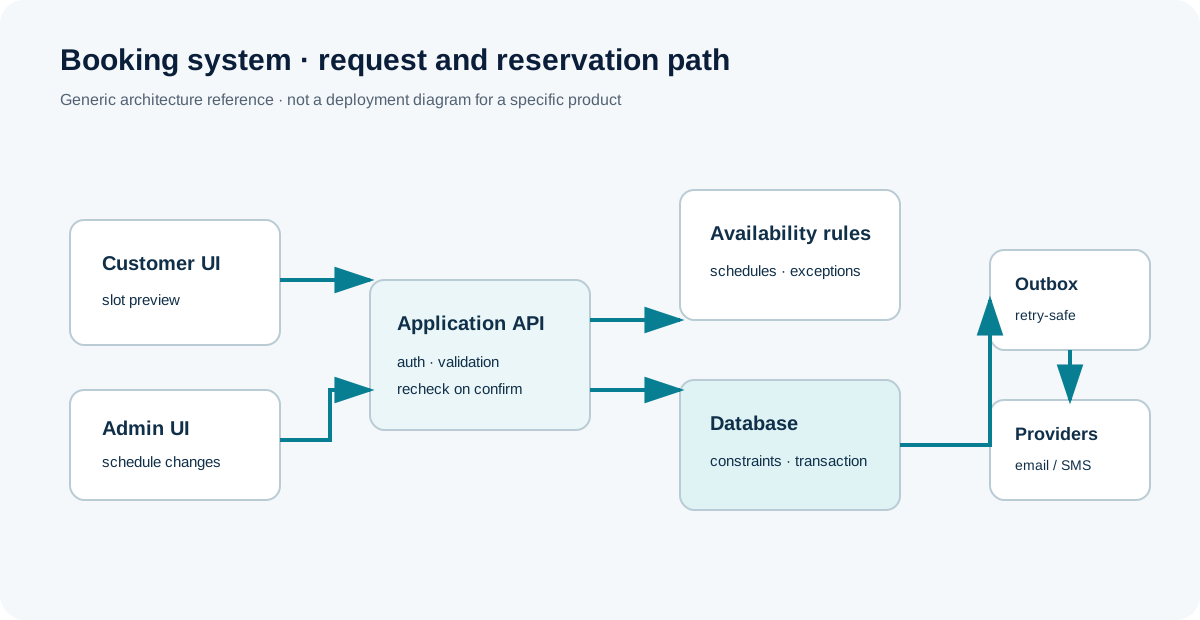
Keep customer booking, administration, trusted write operations, availability calculation, and provider notifications as explicit responsibilities. A browser can preview availability, but server-side code must validate the final request. Keep secrets on the server and make external provider failure behavior visible to operators.
3. Model ownership, catalog, and reservations
Represent tenant/business ownership, locations, customers, services, staff eligibility, schedule rules, exceptions, appointments, and their lifecycle. Use foreign keys and tenant-aware policies. Preserve historical booking details when catalog values may change. Select overlap protection based on whether bookings use fixed slots or variable intervals.
4. Calculate availability as a constrained interval
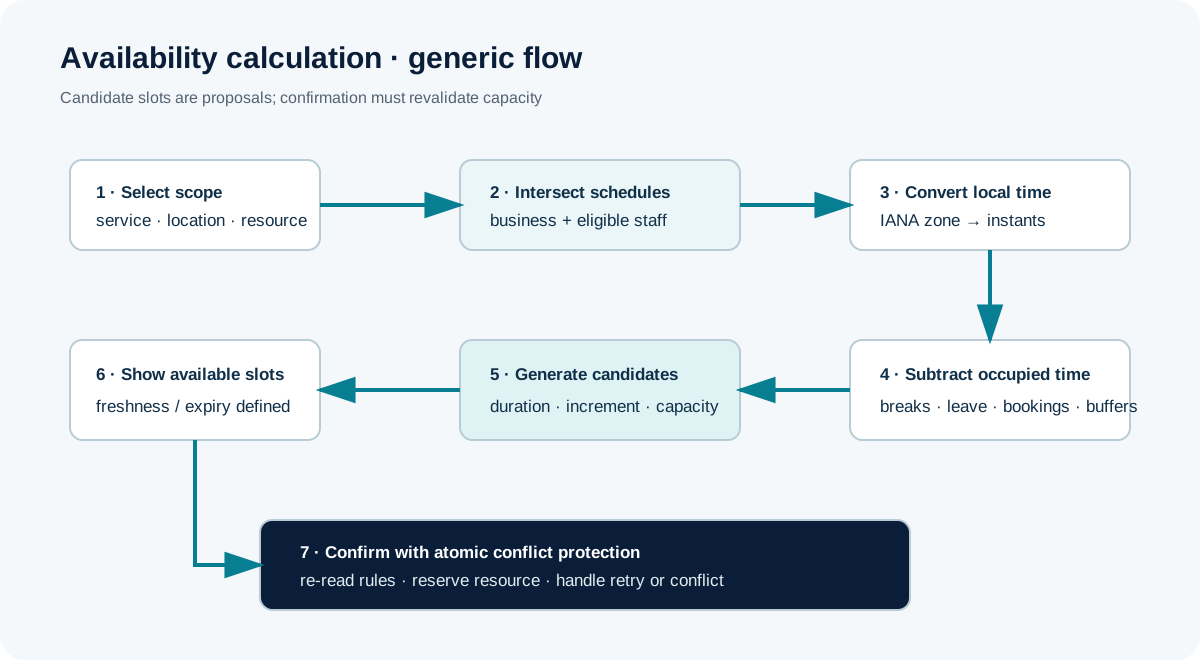
Intersect business opening hours with eligible staff/resource schedules. Remove breaks, time off, and occupied reservations. Apply service duration and buffers consistently. Convert local schedule rules using the business IANA time zone, then compare instants. Define daylight-saving gaps/repeats and any temporary holds.
5. Make booking transitions explicit
Define states such as requested, confirmed, checked in, completed, cancelled, and no-show, along with legal transitions and actors. A cancellation should release capacity consistently; rescheduling should secure the replacement slot without losing the original if the new reservation fails. Keep an audit trail proportionate to operational needs.
6. Design administration around real operations
Staff need to manage schedules and exceptions, review appointments, and understand why a slot is unavailable. Provide role-based access, helpful empty/error states, clear time zones, and safe correction paths. Avoid treating a dashboard as a substitute for authorization or audit design.
7. Test failure and concurrency paths
Cover permissions, tenant isolation, adjacent intervals, buffers, daylight-saving changes, two simultaneous confirmations, duplicate retries, cancellation, rescheduling, notification failure, and mobile booking. Include database constraints and recovery scenarios in tests; a successful click-through alone does not verify these cases.
8. Deploy with explicit operating ownership
Document required accounts, secrets, migrations, backups, monitoring, rollback, and provider dependencies. Assign who maintains the app and handles booking issues. A source package or deployment configuration does not provide hosting or ongoing operations by itself.